Category Page health

Ted Ostrem

As it regards fireman and EMTs doing underwater training in the winter time, at least the air temperatures have been mild lately, regardless of the chill of the water. This is NOT a training day that First Responders look forward to. It's damn cold in there, regardless of your wet or dry suit. It's essential practice, with poor visibility, mind and muscle numbing cold, and the requirement to focus on whatever your underwater mission is. Many of these small town EMT and firemen are volunteers who never were on swimming teams. They learned how to swim at the local pool or back 40 pond, but weren't technically trained. Yet they still overcome any personal fears out of fear of NOT rescuing someone who needs them. God bless each and every one of them, and I hope nobody reading this ever needs them.

justme

The man over the health, making decisions for this country Robert F. Kennedy Jr. got a brain worm (likely a pork tapeworm larva) by ingesting its eggs, probably while traveling in Asia, South America, or Africa, where the parasite is more common. He described experiencing memory loss and brain fog, which led doctors to discover the parasitic cyst in his brain, though it eventually died and required no treatment. How It Happens (Neurocysticercosis): Ingestion of Eggs: A person gets infected by swallowing eggs from the pork tapeworm, Taenia solium, often through contaminated food or water. Larvae Travel: The eggs hatch, and the larvae travel through the bloodstream to other organs, including the brain. Cyst Formation: In the brain, the larvae form cysts, a condition called neurocysticercosis. RFK Jr.'s Experience: Symptoms: He reported severe memory loss and brain fog, leading to a diagnosis where doctors found a dead parasite cyst in his brain. Location: He suspected he contracted it during travel in South Asia. Resolution: The infection resolved on its own, with the parasite dying and no specific treatment needed for the cyst. While he mentioned high mercury levels as a potential cause for brain fog, the parasite infection was identified as the source of the cyst

justme

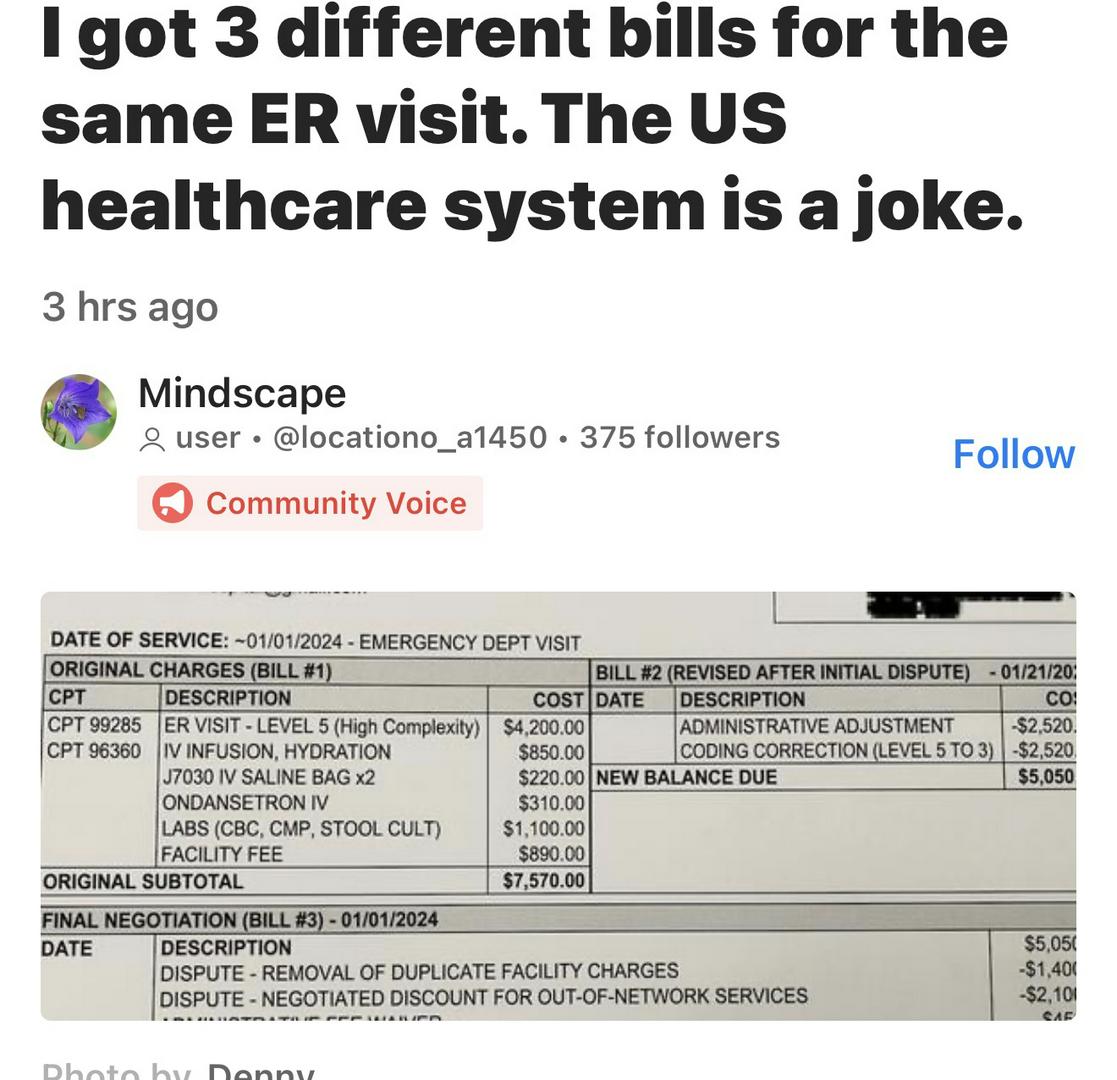
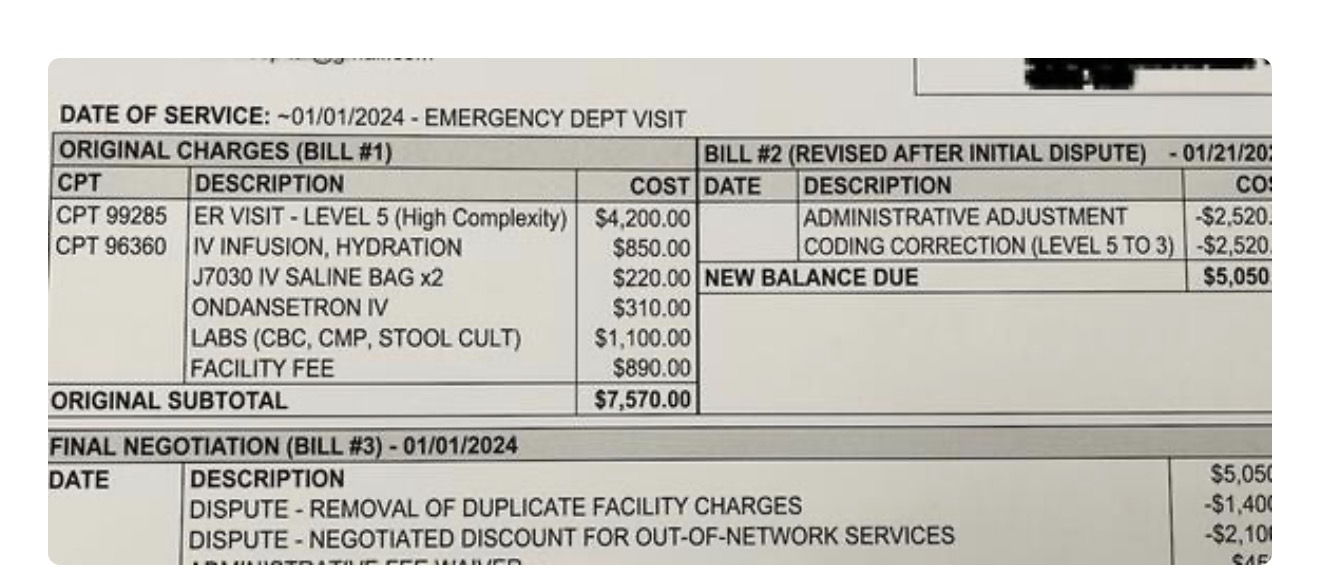
OPINION I got 3 different bills for the same ER visit. The US healthcare system is a joke. 3 hrs ago Mindscape Mindscape user • @locationo_a1450 • 375 followers Community Voice Follow https://img.particlenews.com/image.php?url=0OcH9v_19ggckeC00 Photo byDenny Last year, I got hit with a vicious stomach bug—uncontrollable diarrhea, a 103-degree fever, and severe dehydration. I dragged myself to the ER at 2 AM. They hooked me up to a couple bags of IV fluids, gave me a bunch of meds, and sent me home to "wait for the bill." Bill #1 arrived: $7,570. For diarrhea and saltwater. I was panicking, but a friend told me to run the statement through an app called Billguard. I scanned it, and the app immediately flagged the BS—they coded my visit as a Level 5 (life-threatening trauma) and charged insane markups on basic meds. Armed with the app's breakdown, I called billing, argued the specific codes, and pointed out the overcharges. They gave me the classic, "We’ll review your account." Weeks later, Bill #2 arrives: $5,050. Better, but still a total scam. I scanned it again. The app pointed out that they still left duplicate facility fees on there. I called back, read off the new proof, and fought them again. They said, "Let us check into that," and then... radio silence. Months went by. Finally, Bill #3 showed up in the mail for just over $1,000. It seemed close enough to reality, so I just paid it to be done with them. The US medical billing system is intentionally chaotic. They bank on you being too intimidated or tired to fight back. If you have crazy money, you can hire a professional medical billing advocate. But if you don't, just scan your bills with a tool like this and do the arguing yourself. It’s an exhausting, frustrating game, but forcing them to drop a bill by $6,500 proves that you should never pay the first number they send you.

justme

Deadly fungus that will ‘eat you from the inside out’ is quickly spreading around the world By Eric Ralls, Imagine inhaling hundreds of invisible spores every day. Most float in and out of our airways without leaving a trace. Yet some of those spores belong to molds that don’t respect boundaries. Many fungus species will infect lungs, spoil crops, and disrupt ecosystems all at the same time. In short, they can wreak massive havoc and leave death in their wake. Most molds and fungi are helpful, but some fungus and mold will jump from hospital wards to honeybee hives, and the line between helpful recycler and harmful invader grows blurrier each year. Most of the time, healthy immune systems swat away dangerous spores and fight off infection. Trouble arises when weakened defenses, rising temperatures, and heavy fungicide use tip the scales. Suddenly, the same fungus that quietly decomposes the fallen leaves in your yard can trigger relentless coughs, damage corn silos, and shrug off medicines that once kept it in check. Aspergillus fungus easily adapts After studying fungal threats for years, Dr. Norman van Rhijn and colleagues at The University of Manchester mapped how three notorious Aspergillus species – A. flavus, A. fumigatus, and A. niger – might spread through the end of the century. They fed climate change scenarios into global models and watched the virtual spores drift. Aspergillus fungus thrives because its genome bends easily to new pressures. It lives on soil, grains, animal feathers, even coral skeletons. Out in the wild, it recycles nutrients, but on farms and in clinics, the story shifts. Farmers spray azole fungicides to protect wheat and peanuts; doctors use nearly identical azole drugs to save patients with lung infections.

Rick And Morty

1. No one is coming.
Not a savior, not a fix, not even understanding. The people who say they care still choose themselves first when it matters. You wait for rescue and you wait forever. 2. Every mistake you make will feel permanent right now.
The words you can’t take back, the chances you let slip, the nights you wasted—they burn. Most fade. The ones that stay are the ones you never tried because fear won. 3. Pain arrives uninvited and stays as long as it wants.
Loss of people, health, hope, money, time—it finds you. Running makes it chase harder. Facing it leaves marks, but those marks prove you survived. 4. Everyone is protecting their own skin, yourself included.
Kindness is rare because self-preservation is louder. Stop expecting loyalty that costs someone else comfort. Guard your own peace instead. 5. Your time is leaking away this second.
Every minute spent replaying the past, fearing the future, or numbing out is gone. You are not promised another hour. What you do in the next breath is the only currency that counts. 6. Real closeness requires showing the ugly parts.
The anger, the shame, the neediness. Most will leave when they see it. A few stay. That staying is the closest thing to proof you are not alone. 7. You control almost nothing—except your next small action.
Weather, other people’s choices, random illness, luck—no say. But you decide whether to stand up, eat something decent, speak honestly, or walk away. Chain those decisions and the cage loosens. 8. Chasing happiness directly leaves you empty.
It slips away when grabbed. Build something worth doing—work, care for someone, learn, create—and meaning sometimes brings happiness along without asking. 9. Everyone hides their fear.
The confident ones, the successful ones, the ones who look put-together—they are all pretending harder than you realize. You are not the only one struggling to breathe. 10. One day it ends and none of this intensity will matter the way it does tonight.


Annabelle Linn

The instant breath leaves the body, life does not vanish — it unravels. Not in silence, but in a slow, invisible collapse. The brain is the first to surrender, starved of oxygen, its neurons flickering out like dying stars. The heart follows, then the great engines of the body — the liver, the kidneys, the pancreas — each fighting for a few more desperate moments before the dark settles in. And yet… the body is not done. Beneath the still skin, a quiet rebellion continues. The cells of the cornea, the tendons, even the heart valves, hold on for hours. Skin endures for a day. White blood cells, the soldiers of our immune system, march on for nearly three. Scientists call it the twilight of death — that eerie window when life lingers in fragments. Deep inside, certain genes awaken as if unaware the war is lost, transcribing DNA into RNA in a last act of defiance. It’s as if the body whispers, “Not yet.” But this defiance has a cost. In organ donors, some of these frantic postmortem cells mutate — their chaos carried into another life, perhaps explaining why some transplant recipients face strange, higher risks. Death, it seems, is not a line but a landscape — a passage where some parts of us resist the end, even as the rest fades to silence. Because life doesn’t stop all at once. It fades, cell by cell, whisper by whisper — and in that fading lies the final mystery of being alive.

Category: Health - Page 9 | LocalAll