Tag Page news

#news
Curiosity Corner

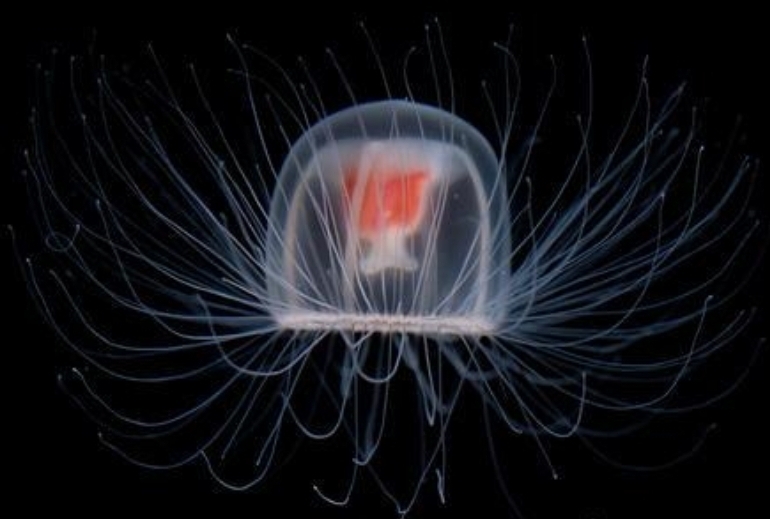
Eternal Life: The Jellyfish That Reverses Its Own Life Cycle The tiny jellyfish Turritopsis dohrnii is one of the few organisms known to effectively escape permanent death, not by living forever in one form, but by repeatedly resetting its life cycle. Barely a few millimeters wide, it inhabits warm oceans worldwide, yet carries a biological capability that challenges the standard model of aging. Most animals move in a single direction: birth, growth, reproduction, decline, and death. This species can interrupt that process entirely. When stressed by injury, starvation, or environmental change, the adult jellyfish initiates a transformation driven by transdifferentiation. Its specialized cells revert and reorganize into different types, collapsing the organism into a cyst-like state before reforming as a polyp, the earlier juvenile stage of its life. From that polyp, new jellyfish bud off, genetically identical to the original. This process can begin within days under lab conditions, showing how rapidly the reset can occur. In controlled settings, this reversal has been observed multiple times in the same organism, meaning there is no fixed biological limit forcing death through aging. It can still die from predators or disease, but not from internal deterioration. In effect, it bypasses the gradual cellular damage that defines aging in most species. During the reversal phase, gene activity linked to stem-cell renewal and tissue regeneration sharply increases, effectively reprogramming mature cells into more primitive states. This makes Turritopsis dohrnii a rare case in which life does not strictly move forward. Instead, it loops, demonstrating that under certain genetic conditions, aging is not an unavoidable endpoint but a process that can, at least in one species, be reversed. #Biology #Science #ScienceNews #OceanLife #News #USNews

1776 Patriot

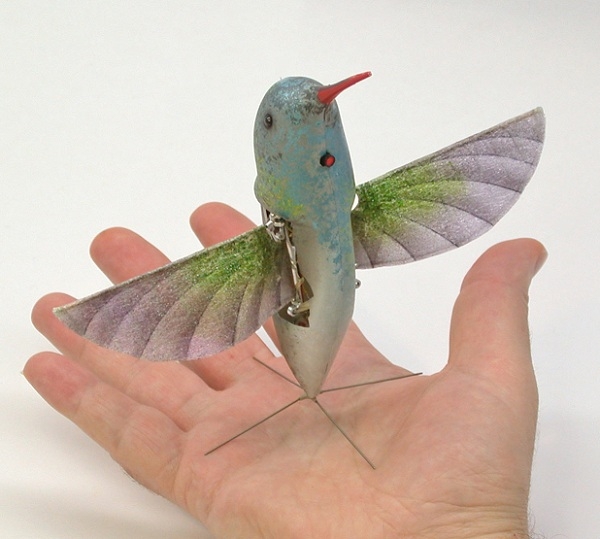
DARPA’s Nano Air Vehicle Program In February 2011, AeroVironment unveiled the world’s first fully operational, life-size, hummingbird-like flying machine for the Defense Advanced Research Projects Agency. Built under DARPA’s Nano Air Vehicle program, the tiny craft marked a milestone never before achieved. The handmade prototype weighs just 19 grams, or two-thirds of an ounce, including batteries, motors, communications gear, and a video camera. That is lighter than a common AA battery. Its wingspan stretches 16 centimeters, or 6.5 inches, tip to tip. Engineers could slip on a removable body fairing shaped exactly like a real hummingbird. The result looked so convincing that it was larger than an average hummingbird, yet smaller than the largest species found in nature. It flew using two flapping wings for both power and steering, with no tail or extra control surfaces. Under remote control, it climbed and descended vertically, slid left or right, raced forward and backward, and rotated clockwise or counterclockwise. It hovered precisely inside an imaginary two-meter-wide sphere for a full minute. It held steady in five-mile-per-hour side gusts, drifting less than one meter. It stayed aloft for eight straight minutes on its own batteries. Pilots pushed it to 11 miles per hour in forward flight, then eased it back into a perfect hover. They even flew it indoors while watching only the live video feed. The goal was simple yet bold: to give American forces eyes that could enter the tightest urban spaces without warning. It could outmaneuver wind, slip through doors, and relay crystal-clear video from places too dangerous for soldiers. The Hummingbird fulfilled its role as a technology demonstrator. It never entered mass production, but its breakthroughs in nanoscale power, control, and miniaturization lived on. AeroVironment drew directly from those advances to create the Snipe, a palm-launched nano quadrotor system. #Military #Spytek #News #USNews #USA #America

Tag: news - Page 2 | LocalAll