Tag Page nationalgrid

#nationalgrid
Cris

Understanding National Grid’s Role in Upstate New York – Not a True Monopoly I recently looked into the so-called “monopoly” of National Grid and found out the following: National Grid does not hold a statewide monopoly on electricity or natural gas services. Instead, it functions as a regulated monopoly within its designated service territories, primarily in upstate New York, where it is the sole distributor responsible for infrastructure maintenance and delivery. This model is standard in the utility sector to avoid inefficient duplication of infrastructure, such as power lines and pipelines, which could increase costs for consumers. The origins trace back to Niagara Mohawk Power Corporation, a New York-based utility established in 1937 (with roots to 1929) and headquartered in Syracuse. In 2001-2002, amid U.S. energy deregulation policies from the late 1990s and early 2000s, it was acquired by National Grid plc, a United Kingdom-based multinational, for approximately $3 billion. These policies aimed to enhance competition and efficiency through international investments. New York State has multiple utilities: for example, Consolidated Edison serves New York City and Westchester; New York State Electric & Gas (owned by Spanish firm Iberdrola) covers southern and western areas; and municipal utilities exist in places like Jamestown. For energy supply, consumers can choose from competitive providers known as Energy Service Companies (ESCOs). National Grid operates under oversight from the New York State Public Service Commission to ensure fair rates and reliability. For those concerned about foreign ownership or rates, I recommend contacting the PSC or local representatives. What are your thoughts? Has anyone switched to an ESCO? #NationalGrid #EnergySavings #NYS #UpstateNY

Cris

How to Read Your National Grid "Budget Plan" Statement To avoid the "True-Up" shock, you need to look past the "Total Amount Due" and focus on the Account Summary section of your bill. This is where the math behind the curtain is revealed. The Three Red Flags to Watch For 1. The Deferred Balance (The "Hidden Debt") • Where to find it: Usually located under the "Budget Billing Summary" section. • The Math: This is the difference between the cost of the energy you actually used and the budget payments you've made. • The Trap: If this number is a large positive balance halfway through your plan year, your monthly payment is likely too low. National Grid will eventually "catch up" by either spiking your monthly bill or sending a massive bill in Month 12. 2. Actual vs. Budget Comparison • Where to find it: Look for a line titled "Actual Charges Since Last Settlement." • The Math: Compare this to "Budget Charges Since Last Settlement." • The Trap: If your Actual Charges are consistently higher than your Budget Charges, you are effectively taking an interest-free loan from the utility company that must be repaid in full the moment you move out or cancel the plan. 3. The "Review Month" Notice • Where to find it: The "Important Messages" box on the first or second page. • The Warning: National Grid usually reviews these plans every 3, 6, or 9 months. If you see a message stating your "Budget amount has been adjusted," check your new amount immediately. If it has jumped more than 15%, it’s a sign that the 2026 rate hikes are outpacing your current payment plan. Quick Audit Checklist • [ ] Is my Deferred Balance over $200? (If yes, expect a payment hike soon). • [ ] Am I in "Month 11" of my plan? (Prepare for the Month 12 "Settlement" bill). • [ ] Did I just install a new appliance or heat pump? (The budget plan won't account for this increase until the next review). #nationalgrid #AffordableNY #AffordableLiving #NYS

Cris

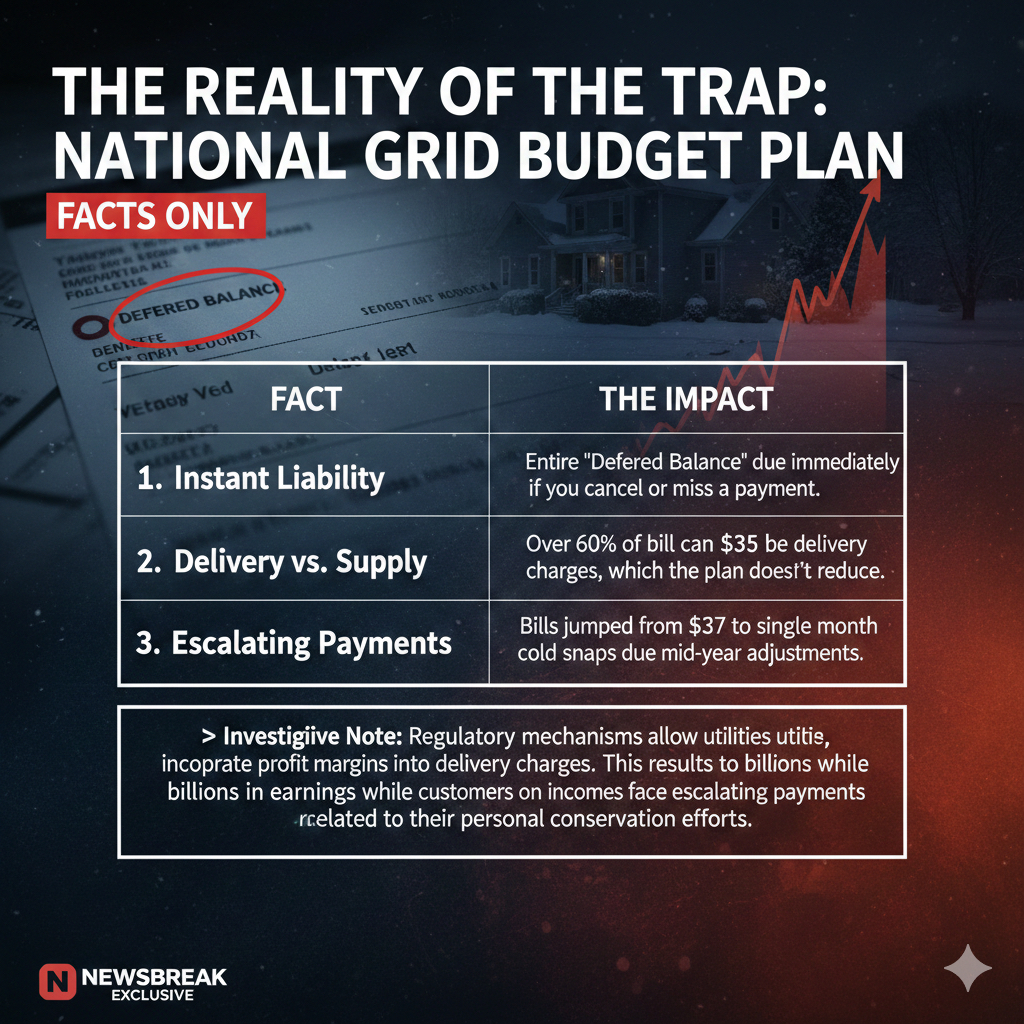
National Grid Budget Plan: Safety Net or Debt Trap? As utility costs hit record highs in 2026, many are turning to National Grid’s Budget Plan for stability. But regulatory filings reveal a "hidden debt" system that can lead to massive sticker shock. The Good: Predictability • Level Payments: Annual costs are split into 12 equal installments to avoid winter/summer spikes. • Support: Can be paired with arrears forgiveness (up to $12,000) for eligible accounts. The Bad: The "True-Up" Debt • Not a Discount: You still pay for every kWh used. It only changes when you pay. • 12th Month Shock: If usage exceeds estimates, the "Settlement Month" requires a lump-sum payment for the difference. • Underestimation: New residents often face year-end balances of $100+ because plans are based on previous tenants' habits. The Ugly: Regulatory "Gold-Plating" • Delivery Hikes: National Grid passes $500M+ in yearly infrastructure costs to users. These "delivery charges" inflate bills even if you conserve energy. • The 50% Jump: Due to 2026 "Future Grid" surcharges, some "fixed" payments have spiked 50% mid-year. • Conservation Penalty: Since bills are averaged, there is no immediate financial reward for lowering your thermostat, discouraging efficiency while utility profits remain protected. Bottom Line: The plan offers stability but creates deferred liabilities. If you cancel, the entire balance becomes due immediately. #NationalGrid #AffordableNY

You've reached the end!