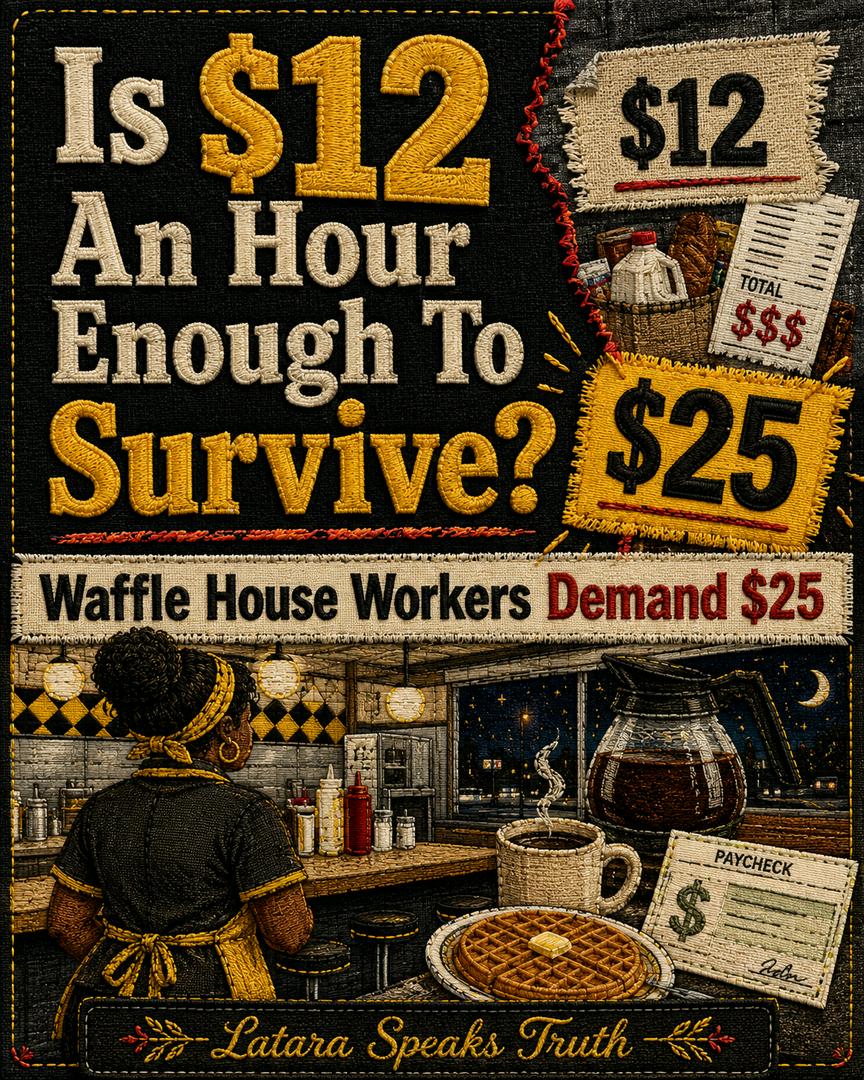
Waffle House workers in Atlanta are demanding $25 an hour, free meals or an end to meal charges, and better security.
And somehow, the response from some people is, “College graduates don’t even make $25 an hour.”
That is not the argument they think it is.
If someone went to college, took on debt, earned a degree, and still makes less than $25 an hour, that does not prove Waffle House workers are asking for too much. It proves too many workers are being underpaid.
One struggling worker should not be used as a weapon against another struggling worker.
A person with student loans should not look at a food service worker and say, “You should struggle too.”
That is not logic. That is misplaced frustration.
The real question is not whether Waffle House workers deserve $25 an hour. The real question is how anybody is supposed to survive on $12 an hour in this economy.
At $12 an hour, a full-time worker makes about $24,960 a year before taxes. That is before rent, food, transportation, utilities, insurance, childcare, medical needs, and emergencies.
In metro Atlanta, MIT’s Living Wage Calculator lists the living wage for one adult with no children at $26.36 an hour. For one adult with one child, it is $40.90 an hour.
So $25 an hour is not luxury money. It is survival money.
And for the people saying nurses or college graduates do not make that much, be specific. Registered nurses nationally have a much higher median wage than $25 an hour. If some healthcare workers or college graduates are making less, that means their pay deserves questioning too.
The answer to low wages is not to keep everybody low.
Full-time work should not still leave people fighting to survive.
Sources: Atlanta News First, MIT Living Wage Calculator, Bureau of Labor Statistics
#WaffleHouse #WorkersRights #LivingWage #CostOfLiving #LaborRights #WorkingClass #PayPeopleFairly