Tag Page Usnews

#Usnews
1776 Patriot

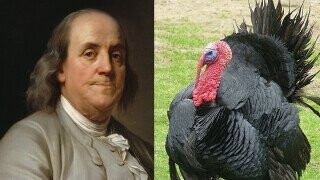
How the Turkey Almost Became America’s National Bird The story of the turkey’s near rise to national symbol begins in the early years of the United States, when leaders were choosing an emblem to represent the new nation. Benjamin Franklin took a special interest in this decision, and in a private letter he shared his belief that the turkey deserved the role more than the bald eagle. He described the turkey as a native species that early settlers and Indigenous communities had long known, hunted, and observed in the wild. To him, this connection made the turkey a more fitting choice for a country trying to define its identity. At the time, wild turkeys roamed across much of North America and were recognized for their strength and surprising agility. They could run up to 20 miles per hour, fly short distances at high speed, and use more than 30 vocalizations to communicate. Settlers often noted how quickly turkeys could react to danger, spotting movement from far away and working together in groups to stay safe. These behaviors shaped Franklin’s view that the turkey represented determination and awareness. The bald eagle, however, carried strong visual appeal and a dramatic silhouette. When the Continental Congress reviewed design proposals in 1782, the eagle appeared on several versions of the Great Seal. Despite Franklin’s private objections, the eagle’s sharp outline and widespread recognition won over the committee. The turkey simply did not gain enough support. Although the turkey did not become the national bird, its place in American life never faded. It continued to be central to farming, hunting traditions, and eventually Thanksgiving celebrations. The story of its near selection remains a unique moment in early American decision making, illustrating how even everyday wildlife played a role in shaping national symbols. #USHistory #History #America #USA #News #USNews #Thanksgiving

Curiosity Corner

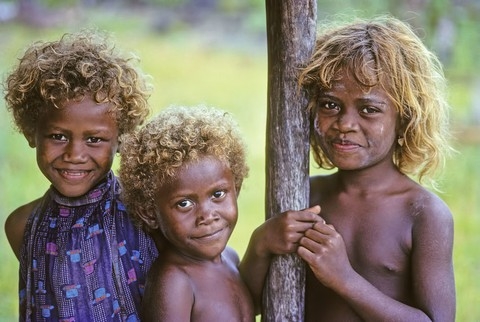
The Unique Blond-Haired People of Melanesia In the Solomon Islands, a small population has a rare trait: dark skin with naturally blond hair. Roughly five percent display full blond hair, and about one in four carry the genetic variant. This trait comes from a change in the TYRP1 gene, which affects hair pigment but not skin. It is distinct from European blond hair and evolved independently. The same variant is less common in nearby islands. Importantly, this gene affects hair color only and does not directly change eye function, lung capacity, or physical performance. These communities are known for strong swimming and diving skills. Many can hold their breath for one to two minutes and dive several meters without equipment to gather food or navigate reefs. Their abilities come from daily interaction with the marine environment, where fishing and diving are essential. Regular practice strengthens lung capacity, oxygen use, and endurance. While lighter hair and occasionally lighter eyes may slightly improve underwater visibility, most diving skill comes from physical adaptation and cultural training. Some freediving populations, like the Bajau, show spleen enlargement to store oxygen, though this has not been measured in Melanesians. From an evolutionary perspective, as Darwin described, traits that improve survival increase in frequency. On isolated islands, the ability to swim, dive, and gather food efficiently provides an advantage. Over generations, individuals excelling at these skills thrive, illustrating natural selection in action. Compared to most people, Melanesians with this trait combine a distinctive appearance with deep-water skills and physical adaptations shaped by environment and culture, showing how genetics and lifestyle interact to produce both striking appearance and practical abilities. #Genetics #Science #ScienceNews #News #USNews #America #USA
You've reached the end!
Tag: Usnews - Page 2 | LocalAll