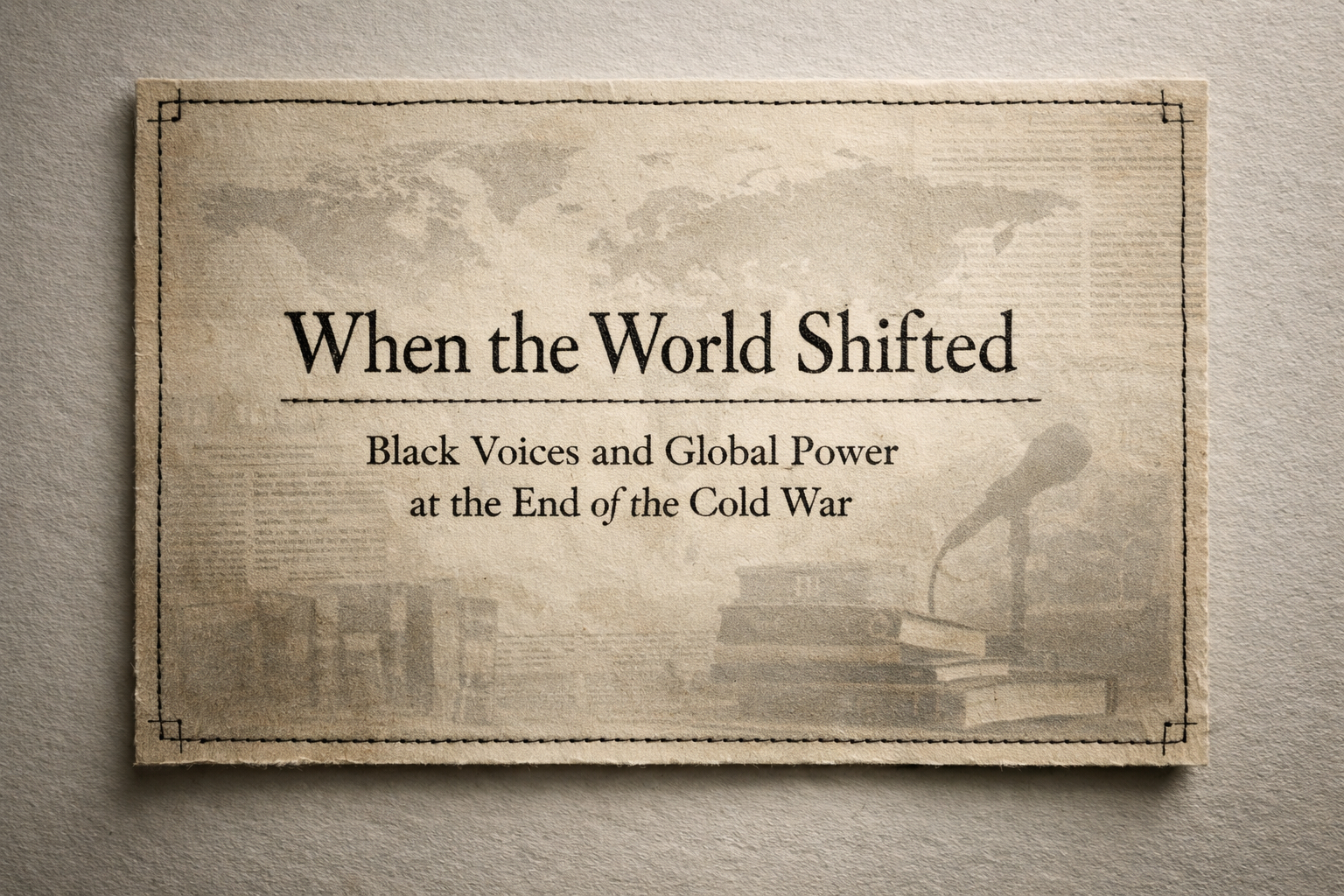
The late 1980s marked a turning point in global power. As the Cold War weakened and long-standing political binaries began to collapse, conversations about race, democracy, and influence expanded beyond military standoffs and ideological slogans. This shift created space for new voices to challenge how power had been defined and who was allowed to interpret it.
During this period, Black Americans in media, politics, and academia played a growing role in reshaping global conversations. Journalists, scholars, diplomats, and cultural critics questioned Cold War narratives that promoted freedom and democracy abroad while ignoring racial inequality at home. They exposed contradictions between American foreign policy and domestic realities, arguing that global leadership required accountability, not just rhetoric.
In universities, Black scholars expanded international studies, political science, and history by centering race as a global force rather than a domestic issue. In media, Black commentators broadened coverage of Africa, the Caribbean, and the African diaspora, connecting global liberation movements to the unfinished struggle for equality in the United States. In politics, Black leaders increasingly addressed international human rights, sanctions, and diplomacy through a lens shaped by both global awareness and historical exclusion.
As the Cold War era faded, discussions of power widened. Influence was no longer measured only through borders and weapons, but through culture, economics, and human impact. This shift mattered because it challenged simplistic definitions of dominance and highlighted a deeper truth: power without justice is fragile. Voices once pushed to the margins helped redefine global dialogue in real time, reminding the world that democracy cannot be separated from how a nation treats its own people.
#ColdWarEra #MediaAndPower #AcademicHistory #GlobalPolitics #AmericanHistory