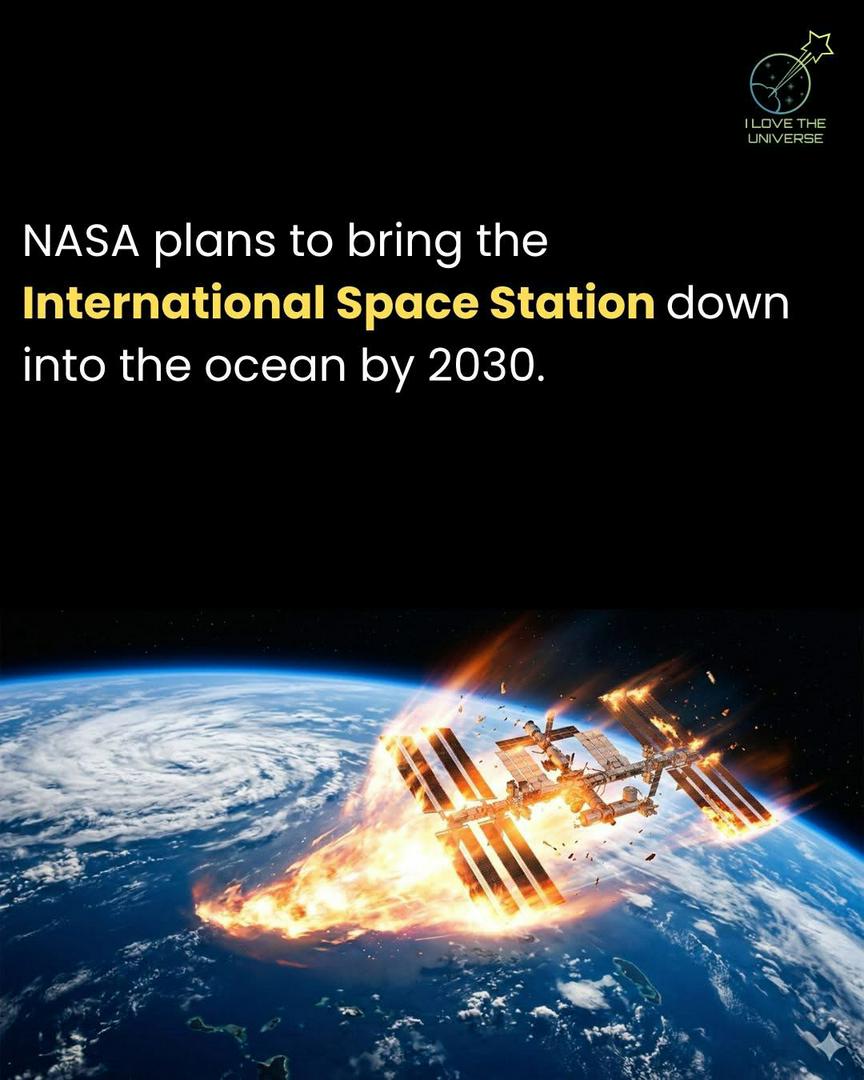
justme +FollowThe International Space Station has been humanity’s home in space for more than 25 years. Over 270 astronauts from more than 20 countries have lived and worked aboard it. The station has orbited Earth over 150,000 times, traveling billions of kilometers through space. Building it was one of the most complex engineering projects ever attempted — requiring over a decade of construction, 27 space shuttle flights, and more than 40 assembly missions. And around 2030, its mission will come to an end. Not because it failed — But because it succeeded. NASA plans to guide the ISS into a controlled reentry, where most of the station will burn up in Earth’s atmosphere. Any surviving debris will fall into a remote area of the Pacific Ocean, far from people or ships. The station will not simply fall from the sky. A special spacecraft will help steer it safely back to Earth. This isn’t the end of human activity in low-Earth orbit. Several commercial space stations are already being developed to replace it — continuing the research and exploration the ISS made possible. The ISS was never meant to last forever. It was meant to open a door. And that door is still wide open. 🌌 #SpaceStation #NASA #SpaceHistory #HumanSpaceflight #SpaceExploration #ILoveTheUniverse #Space #Astronomy #FutureOfSpace41Share
justme +Follow🚨 NASA is set to officially reveal the Artemis III crew on June 9 at 11:00 a.m. EDT during a live announcement from Johnson Space Center in Houston. This marks a major milestone for the future of human space exploration. The astronauts introduced during the event will be assigned to Artemis III — a mission once planned to land humans on the Moon for the first time since Apollo 17 in 1972. But NASA has now significantly reshaped the mission. Instead of being the first Artemis lunar landing, Artemis III is now expected to focus on vital orbital testing between the Orion spacecraft and commercial lunar landers being developed by SpaceX and Blue Origin. According to NASA, the mission will demonstrate key rendezvous and docking operations in Earth orbit — systems considered essential before astronauts attempt future landings near the Moon’s south pole. The mission is currently aiming for launch in 2027. As a result of the updated plan, Artemis IV is now expected to become the mission that finally places humans back on the lunar surface. At the same time, NASA is aggressively expanding its long-term Moon Base ambitions: • robotic cargo deliveries beginning in 2026 • privately developed lunar rovers • scouting drones exploring the lunar south pole • infrastructure designed for a sustained human presence on the Moon NASA says all of this is laying the foundation not just for returning to the Moon — but eventually for sending humans to Mars. More than half a century after Apollo, humanity’s next giant leap is no longer a distant dream. It’s already underway. 🌕🚀 #NASA #Artemis #ArtemisIII #MoonMission #MoonLanding #SpaceExploration #Astronomy #SpaceX #BlueOrigin #Mars #MoonBase #Orion #RocketLaunch #SpaceNews #FutureOfSpace60Share