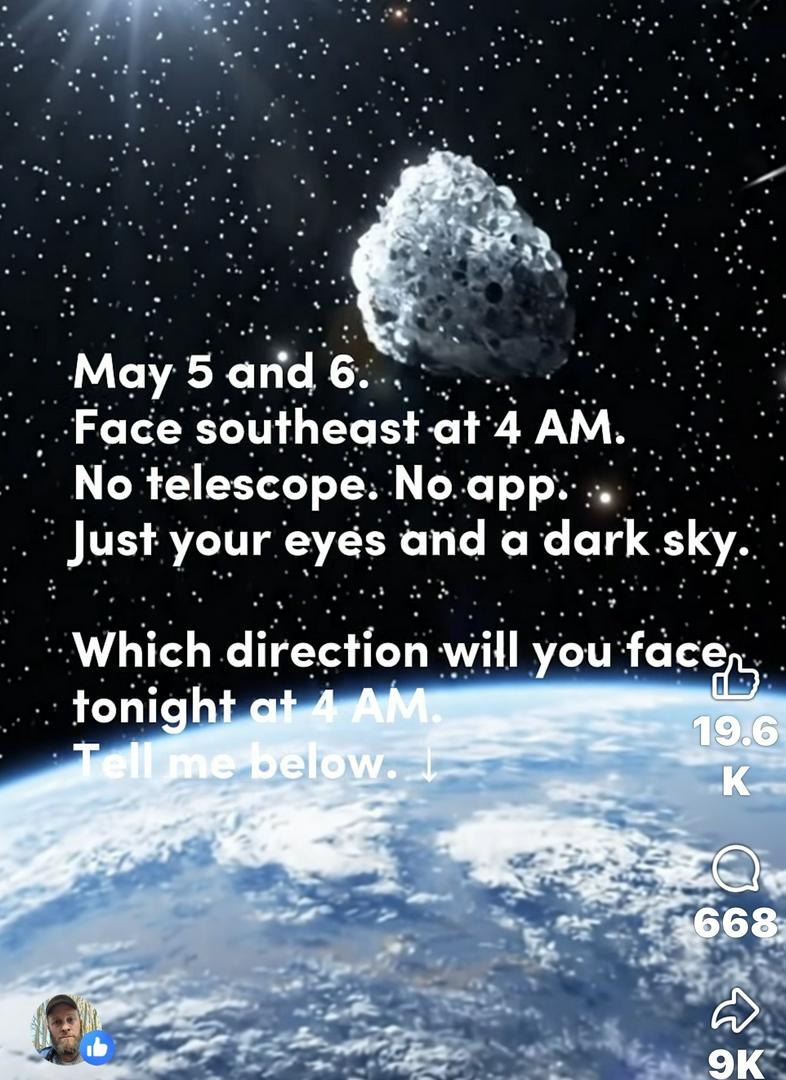
justme +FollowIn 3 nights, Halley's Comet will rain fire in your sky. Not the comet itself. Something better. Every year in early May, Earth passes through the debris field Halley's Comet left behind on its last pass through the inner solar system. That debris field is made of fragments of the comet itself — pieces of rock and ancient ice no larger than grains of sand. When those fragments hit our atmosphere they are traveling at 148,000 miles per hour. At that speed, even a grain of sand becomes a fireball. THE ETA AQUARIIDS. The shower is called the Eta Aquariids because the meteors appear to radiate from the direction of Aquarius in the southeast sky. What makes this shower different from most meteor showers: The meteors are fast. Faster than almost any other annual shower. 148,000 miles per hour produces long bright persistent streaks — sometimes lasting 3 to 4 seconds after the meteor has gone. The peak: May 5 and 6. Rates: 40 to 50 meteors per hour under a dark sky. HOW TO WATCH. Go outside between 3 and 5 AM on May 5 or May 6. Face southeast. Let your eyes adjust for 10 full minutes. Lie down if you can — facing southeast, looking up at roughly 45 degrees. The meteors will run parallel to the horizon — long horizontal streaks instead of the vertical streaks you see in other showers. This is the signature of Halley's Comet debris. AND HERE IS WHAT TO HOLD. Every streak of light you see on May 5 and 6 is a piece of Halley's Comet — an object humans have tracked for over 2,000 years. Julius Caesar's era. Genghis Khan's era. Every generation that has ever looked up in May. They saw the same comet's fire. And on May 5 and 6 so will you. Which direction will you face at 4 AM on May 5. Tell me below. ↓ #EtaAquariids #HalleysComet #MeteorShower2026 #MeteorShowerMay2026 #NightSkyMay #Stargazing #MoonlitWhispers #EtaAquariidsMeteorShower50Share