1/1

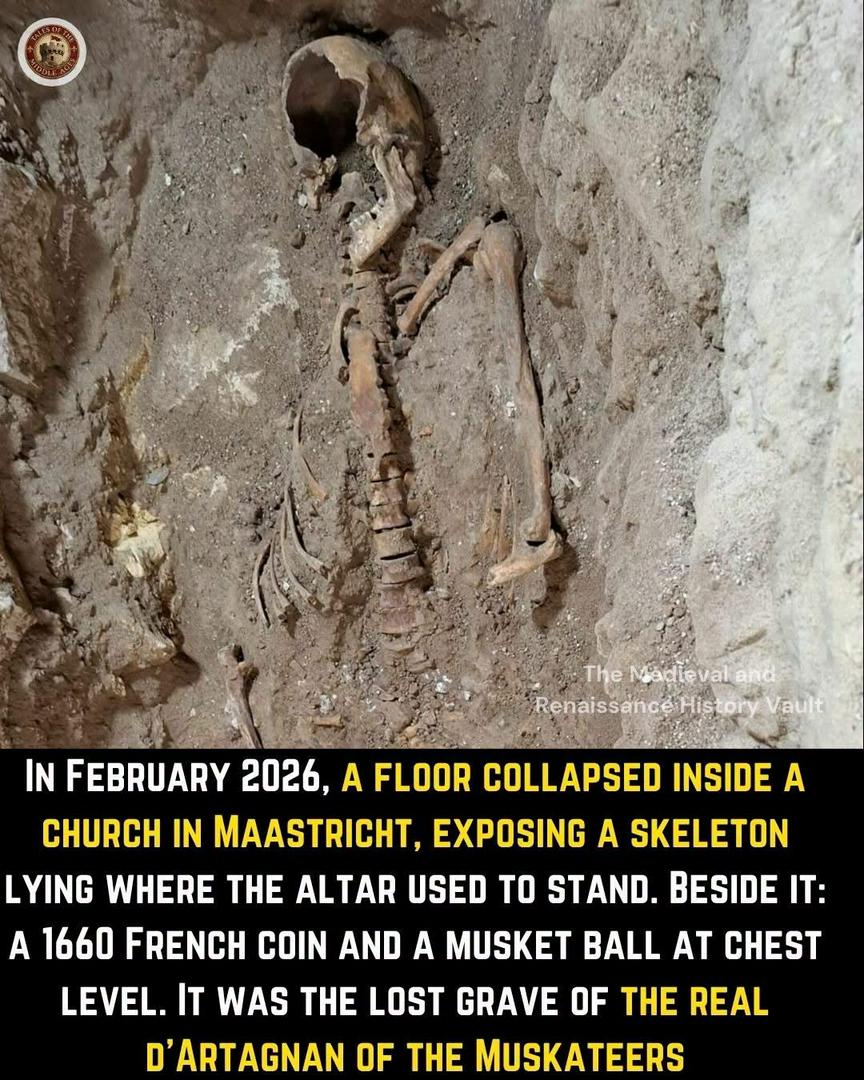
In February 2026, workers repairing a collapsed floor in the Church of Saints Peter and Paul in Maastricht uncovered a skeleton lying directly in front of where the altar once stood. The deacon, standing over the first exposed bone, said he was 99% certain who it was. Two people in particular had been waiting a very long time for that sentence. Odile Bordaz, a French historian, had spent 25 years arguing this church was the burial site. Wim Dijkman, a Dutch archaeologist, had spent 28 years trying to get permission to dig. Neither of them had been able to prove it. Then a floor caved in and did the work for them. Beside the skeleton, in the nave, were two objects that made the case harder to dismiss. A French coin from 1660, minted under the authority of the bishop who would later preside over a royal mass for Louis XIV. And a lead musket ball, lodged at chest level. The man they think is lying there is not the swashbuckler Alexandre Dumas invented in 1844. He's the real one. Charles de Batz de Castelmore was born around 1611 in Gascony. He became a career soldier and a covert agent for Cardinal Mazarin, the kind of man kings send when they can't afford to be seen sending anyone. When Louis XIV needed someone to guard his disgraced finance minister Nicolas Fouquet under house arrest, he picked de Batz and left him on the job for four years. He wouldn't trust it to anyone else. By 1667, de Batz was the effective commander of the Musketeers of the Guard. In 1673, around 60 years old, he was pulled from a provincial governorship he hated and sent to the siege of Maastricht. On June 25, a musket ball hit him in the throat. He was buried somewhere near the battlefield, in a hurry, and the location was lost. For 353 years, the real d'Artagnan has been a name without a grave. A DNA sample has now been taken from the jawbone and sent to a lab in Munich, where it's being compared against living descendants of the de Batz family. Results are expected within weeks. 3
4 hours ago
write a comment...