1/1

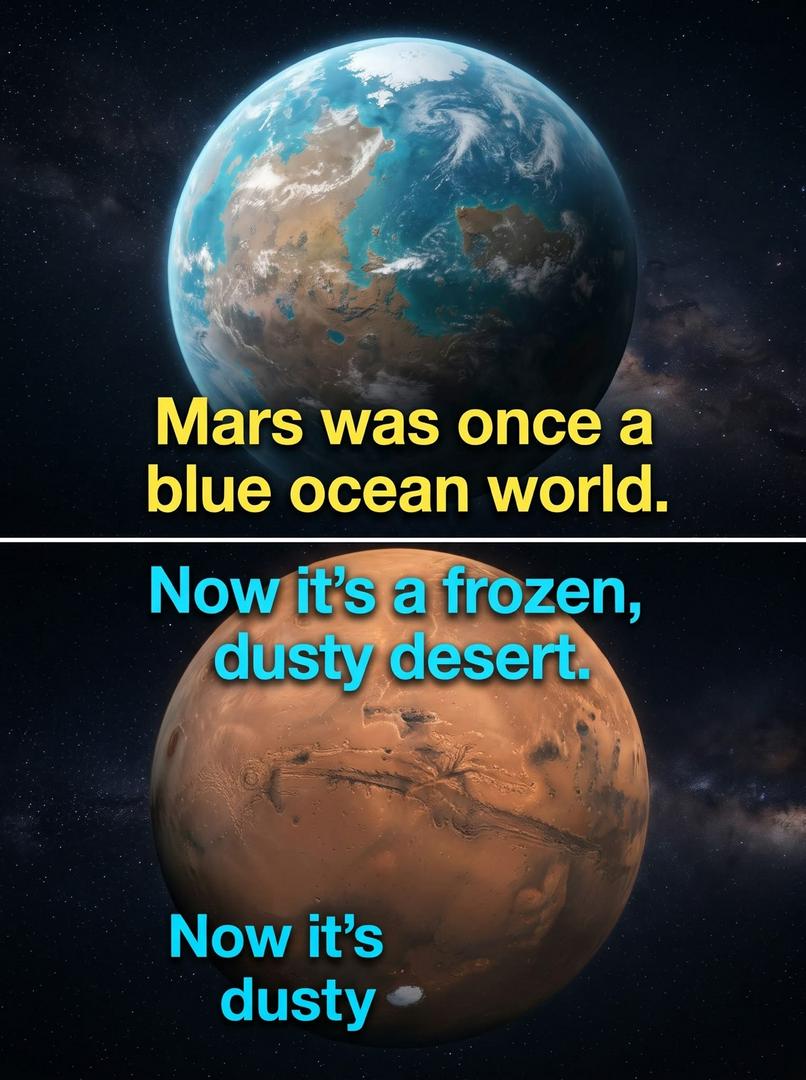
Mars looks like a frozen desert today, but its surface preserves evidence that liquid water once flowed across the planet. Ancient river channels, lakebeds, deltas, and water-altered minerals show that early Mars had environments where liquid water was stable at the surface. How long those conditions lasted, and how widespread they were, remains an active area of research. Mars also changed dramatically as its interior cooled. Its global magnetic field disappeared very early in the planet’s history, leaving the upper atmosphere more exposed to the solar wind. NASA missions have found evidence that Mars gradually lost much of its atmosphere to space, making it increasingly difficult for liquid water to remain stable on the surface. But the water didn't simply disappear. Some became trapped as ice beneath the surface and at the polar caps. Some water is bound within minerals and rocks, while hydrogen from water has also escaped into space over geological time. NASA’s MAVEN mission has helped scientists study how atmospheric loss contributed to Mars becoming the cold, dry world we see today. Mars is therefore less a story of a planet that simply “lost its oceans” and more a record of water being redistributed, locked away, and gradually lost through several processes over billions of years. Its ancient landscapes are still telling us what happened. #marseille #MarsWater #PlanetaryScience #astronomy #space #MarsExploration #astrobiology #solarsystem #NASA #science
1 days ago
write a comment...