1/1
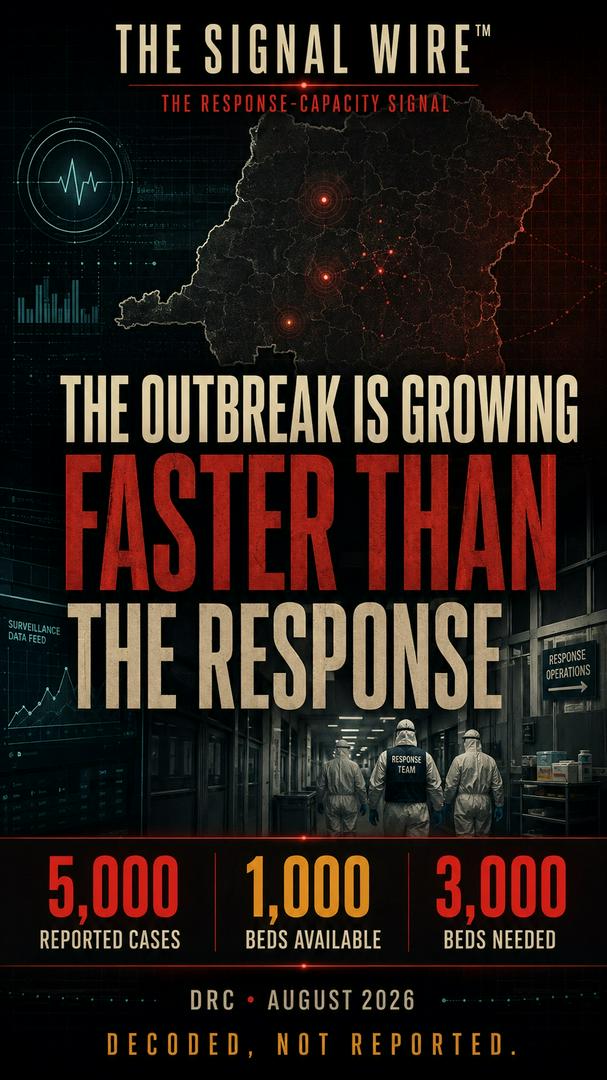
JUST IN: Ebola Outbreak Is Outpacing Response Capacity in the DRC The warning is no longer only about how quickly Ebola is spreading. It is about whether the response system can expand fast enough to contain it. The World Health Organization says approximately 5,000 cases of Ebola disease caused by Bundibugyo virus had been reported in the Democratic Republic of the Congo as of August 18. The outbreak remains a Public Health Emergency of International Concern, but WHO has not classified it as a pandemic emergency. The response-capacity gap is significant: • Approximately 1,000 treatment beds were available • An estimated 3,000 beds were needed • Only about 20% of cases were being detected through contact monitoring • Transmission had expanded from three health zones in May to 55 by August 12 • Forty-nine health zones were experiencing active transmission This is the signal: an outbreak becomes harder to control when case growth exceeds the available treatment, surveillance and contact-tracing capacity. Conflict, displacement, attacks on healthcare facilities, supply shortages and limited access to affected communities are also disrupting the response. In some affected areas, healthcare use has fallen by more than 40%. That means the consequences can extend beyond Ebola to maternal care, malaria treatment, trauma services and other essential healthcare. Uganda has ended its related outbreak after completing 42 consecutive days without a new confirmed case. No outbreak-associated cases have been confirmed in the United States, and the CDC currently considers the risk to the American public very low. The story is that public-health emergencies can accelerate when the systems responsible for detecting, treating and containing them are operating below the level the crisis demands. THE RESPONSE-CAPACITY SIGNAL: What happens when an outbreak grows faster than the system built to contain it? The Signal Wire™ — Decoded, not reported. #PublicHealth #EbolaOutbreak #
9 hours ago
write a comment...