1/1

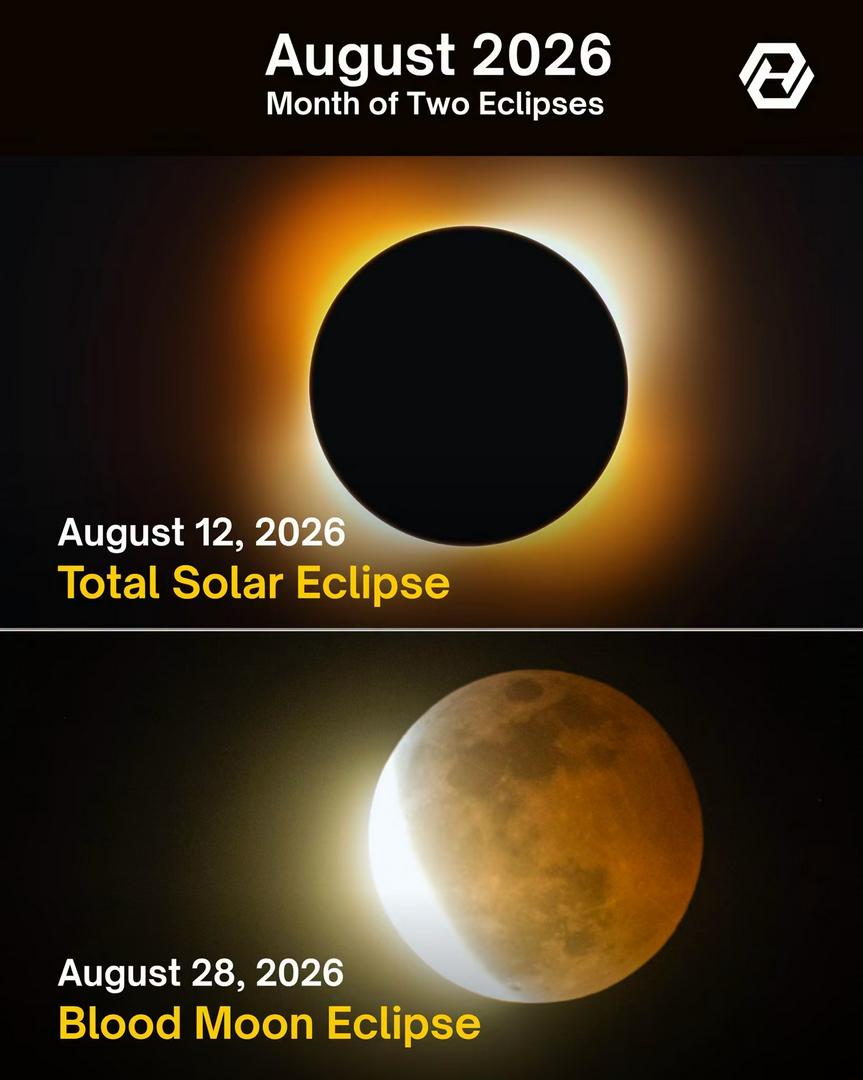
🌑🌕 August 2026: A Rare Month of Two Eclipses! 🌌✨ August 2026 delivers an unforgettable eclipse season, with two spectacular eclipses just 16 days apart—a total solar eclipse followed by a deep partial lunar eclipse. 🌞 August 12 – Total Solar Eclipse 🕒 Maximum Eclipse: 15:46 UTC The Moon will completely block the Sun along a path crossing Greenland, Iceland, northern Russia, and northern Spain, making it the first total solar eclipse visible from mainland Europe since 1999. 🌅 In northern Spain, totality occurs near sunset, creating the potential for a breathtaking Diamond Ring effect just above the horizon. 🌍 A partial solar eclipse will also be visible across much of Europe, North America, and North Africa. ⚠️ Never look directly at the Sun without certified eclipse glasses or a proper solar filter. 🌕🔴 August 28 – Deep Partial Lunar Eclipse (Blood Moon) 🕒 Penumbral Eclipse Begins: 17:34 UTC 🕒 Partial Eclipse Begins: 18:35 UTC 🕒 Maximum Eclipse: 20:12 UTC 🕒 Partial Eclipse Ends: 21:49 UTC 🕒 Penumbral Eclipse Ends: 22:50 UTC With an umbral magnitude of 0.93, nearly 93% of the Moon will pass through Earth's dark shadow, turning much of its surface a stunning copper-red during maximum eclipse. Unlike a solar eclipse, this event is completely safe to watch with the naked eye and will be visible across Europe, Africa, Asia, Australia, and parts of the Americas. 🌌 Why do eclipses come in pairs? Eclipses occur during an eclipse season, when the Sun, Earth, and Moon align with the Moon's orbital nodes. A New Moon can produce a solar eclipse, and about two weeks later, the Full Moon can produce a lunar eclipse. ✨ From the Moon casting its shadow on Earth to Earth casting its shadow on the Moon, August 2026 is truly the Month of Shadows. Don't miss this incredible celestial double feature! #SolarEclipse #LunarEclipse #BloodMoon #EclipseSeason #August2026 #Astronomy #NightSky #Skywatching #Stargazing #Space #Universe #TotalSolarEclipse
10 hours ago
write a comment...