1/1

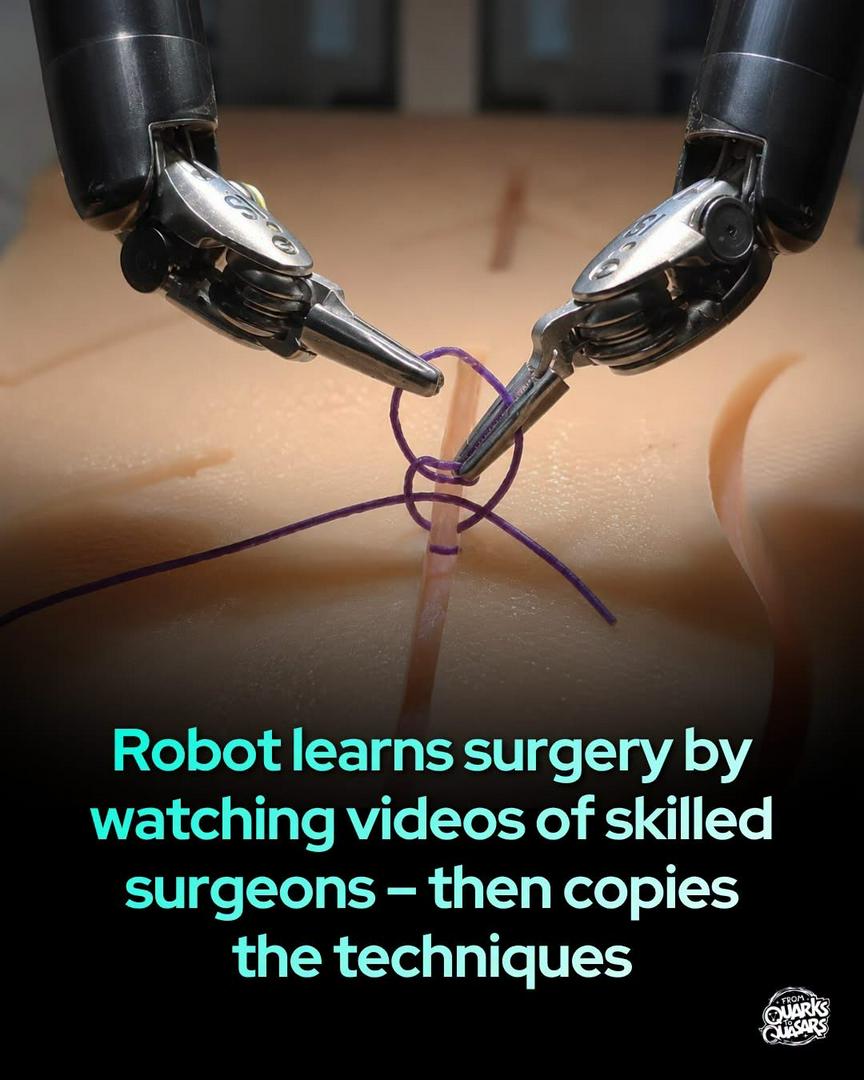
A surgical robot trained to operate by watching videos of human surgeons. Instead of programming every movement by hand, researchers at Johns Hopkins University trained an AI-powered robot using hundreds of videos recorded during real surgeries. After watching experienced surgeons perform procedures, the robot learned to manipulate needles, lift tissue, and place sutures with skill comparable to a human doctor. The breakthrough uses a type of artificial intelligence called imitation learning. Just as humans learn by observing experts, the robot learned by recognizing patterns in the surgeons' movements. Researchers paired the videos with an AI model based on the same transformer architecture behind ChatGPT. But instead of generating words, the system translated what it saw into precise robotic movements. One of the biggest surprises came when the robot encountered problems it had never been taught to solve. If it accidentally dropped a needle, it picked it up and continued operating on its own without being explicitly programmed to do so. The researchers also found the robot could apply what it learned to situations it had never seen before, an important step toward making robotic surgery more adaptable in the real world. Traditionally, teaching a surgical robot required engineers to hand-code every movement, a process that could take years for just a single surgical task. With imitation learning, researchers say a robot can learn an entirely new procedure in just a few days simply by watching surgeons perform it. The team believes this approach could dramatically accelerate the development of autonomous surgical robots, reducing medical errors and eventually allowing AI systems to assist with increasingly complex operations. "Robot that watched surgical videos performs with skill of human doctor." Johns Hopkins Magazine, doctors might be out of a job
2 hours ago
write a comment...