1/1

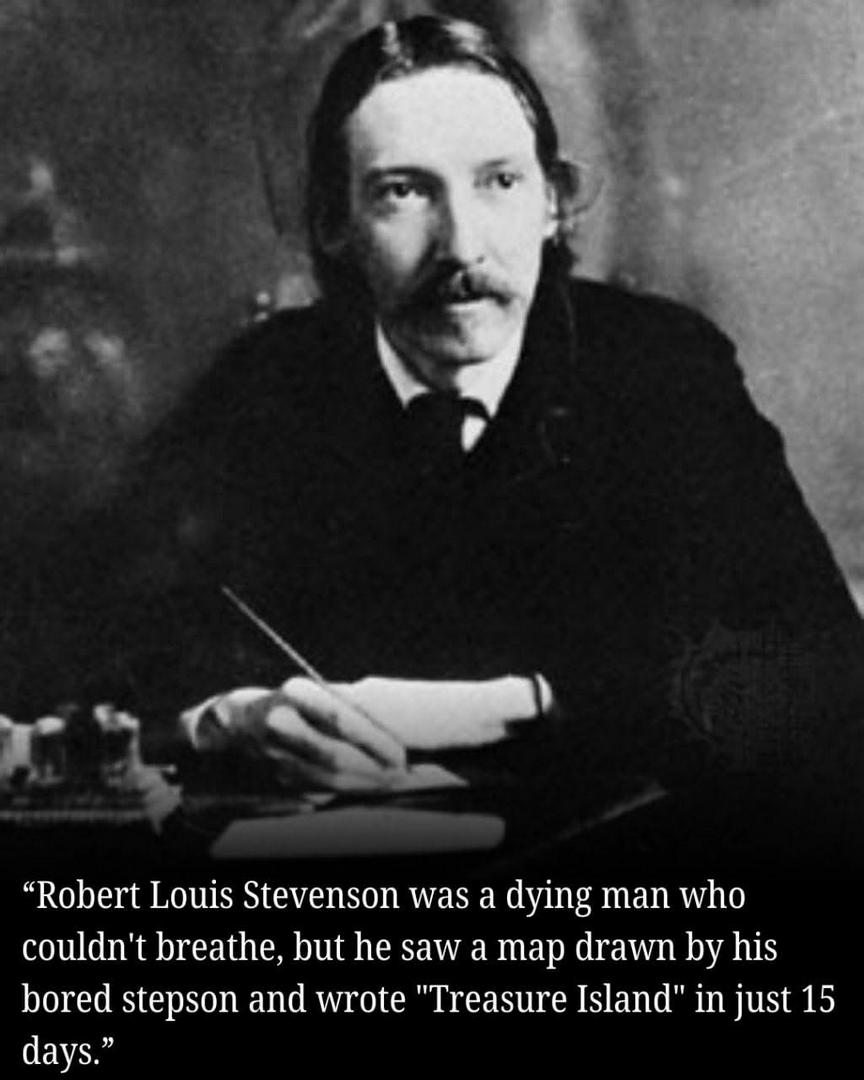
He was a dying man coughing blood into a handkerchief, but in just fifteen days, he looked at a child's drawing and invented every pirate legend we still believe today. Braemar, Scotland. August 1881. Rain lashed the windows of a tiny, cold cottage in the Scottish Highlands. Inside, thirteen-year-old Lloyd Osbourne was trapped by the weather and dying of boredom. With nothing else to do, the boy grabbed a piece of paper and began to draw a make-believe island. He added jagged coastlines, hidden bays, and a large red "X" right in the center. His stepfather, Robert Louis Stevenson, leaned over the boy's shoulder to look at the sketch. Stevenson was only thirty years old, but his body was failing him. Chronic lung disease had turned his life into a series of violent coughing fits and breathless nights. He was a man who lived on the edge of a grave, yet his mind was a furnace of imagination. When he saw that red "X" on the boy's paper, something in his soul caught fire. "That's where the treasure is," he whispered. The high stakes were immediate—Stevenson was broke, his health was declining, and he had yet to write the masterpiece that would save his family. He needed a miracle, and he found it in a child's doodle. Stevenson began to write with a ferocity that defied his physical weakness. He produced an entire chapter every single day, fueled by the desperate need to provide for his wife, Fanny, and her children. Each evening, he read his work aloud to the family gathered around the hearth. Lloyd listened, spellbound, as the ink on the page turned into the swaggering Long John Silver. Stevenson wasn't just writing a book; he was creating a new mythology. Before this moment, pirates didn't have parrots on their shoulders or maps with "X" marking the spot.
28 days ago

Lauren Serven
omg. I never knew that. such incredible life force even though his physical health was failing. I am inspired by this.
28d
Wethersfield, CT
Reply
18

Lester Benner
A remarkable talent and love for his family!
28d
York, PA
Reply
14

David Doran
Well, I continue to learn things about famous authors.
28d
Fort Valley, GA
Reply(1)
12

LaDonna
incredible article. thank you for sharing
28d
Lock Haven, PA
Reply(1)
12

unreal_1
Doc Holiday
28d
Reply(1)
12

Mark Montgomery
and that dumb ass oak island was born
27d
Denver, CO
Reply(1)
11

Gene
dying , is a great incentive to work fast ..
just ask Doc Holiday 😆
28d
Enumclaw, WA
Reply
11

Renee Sullivan
Thank you for this post and EDUCATION OF HISTORY ❣️❣️❣️.
23d
Visalia, CA
Reply(1)
10

jerry stark
I had always heard that Stevenson wrote Treasure Island about Jim Hawkins & Long John Silver while smoking Hashish.👍
25d
Galesburg, IL
Reply
7

GeoBosco3
Robert Lewis Stephenson
26d
Las Cruces, NM
Reply
7
More comments ...
write a comment...