Explore Page

Ann

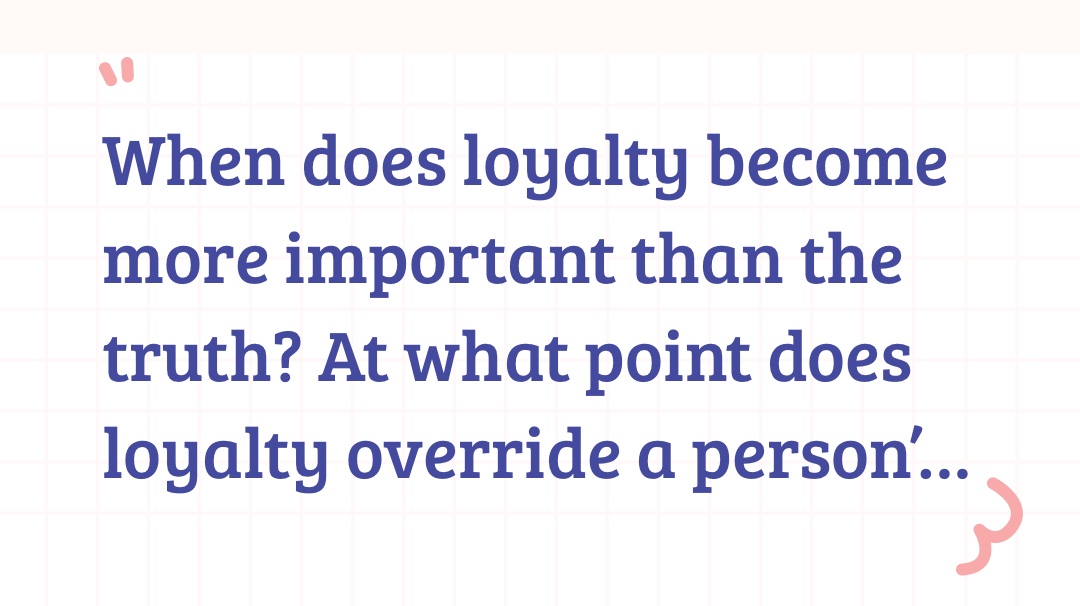
When does loyalty become more important than the truth? At what point does loyalty override a person’s judgment of their true character simply because what they are presenting sounds appealing? Consider a scenario where a salesperson convinces you to buy their product, and you spend your money without questioning its quality or doing further research. This happens because you’ve been shopping there for years and have never had issues despite hearing negative stories. Similarly, you might get into a ride-sharing car without taking necessary precautions simply because you’ve been using them for a long time and have never had problems, despite all the stories you’ve heard. Loyalty is often seen as a strong virtue that binds us to others with trust and care. However, it can also be a reluctance to speak up, a deep fear of disrupting the status quo, or a strong need to belong that overrides our judgment. We may stay quiet and go along, hoping that someone else will speak out. Loyalty is a guideline for connection. It’s a thread that builds a strong connection based on trust and care, especially when things become difficult. Loyalty binds people to their country, family members, and friendships. But what happens when loyalty turns into silence or compliance? This moral dilemma arises in families, workplaces, and communities. These dilemmas often arise in places where we’re expected to “stay loyal” by keeping quiet. But is silence always an act of kindness? Or could it be a way of avoiding discomfort or preserving harmony at the cost of integrity? Should we value loyalty above other values like honesty and respect? Loyalty without reflection and moral reasoning risks becoming a shield for dysfunction or abuse. And when our silence allows harm to continue, are we still being good-hearted or just afraid? “If you’ve maintained a neutral stance in the silence and become complicit in the unfolding events simply because you’re too afraid to speak out, you’re part of the prob

dan

Tips on reading the Bible. All the scriptures written within the Bible revolve around three central themes: the past, the present, and the future. Regardless of whether you read the Old or New Testament, these three themes consistently appear throughout the scriptures. By recognizing these themes, it becomes essential to learn how to rightly divide the word of the Lord, ensuring that each theme is presented in its appropriate sequence. The next crucial aspect to comprehend is the significance of closely examining the gospels for their three central themes. These accounts were meticulously crafted as a recollection of Christ’s teachings. For instance, if you were to read Matthew 24 and perceive the events unfolding in the sequence they are presented in, you might miss a distinct division when Matthew mentions wars, kingdoms clashing, earthquakes, famines, and pestilences. Why? Because this is the sole account they have ever read. Luke, on the other hand, narrates the same events but introduces a preceding occurrence: wars, kingdoms clashing, earthquakes, famines, and pestilences. This suggests that something else was destined to happen first. Therefore, it is imperative to conduct thorough examinations of the gospels, as each writer may recall certain events that the other writer omits. I trust that these insights will assist you in your study of the scriptures.

Neelofer

<b>How Trauma Gets Stored in the Body (and How to Release It) </b> <p style="line-height: 1.30; font-size: 14px;"><img src="https://mymind.org/media/szrjhvpp/unresolvedtraumaarticle_1200_630.png" alt="" width="600" height="315" /> <img src="https://i.ibb.co/s9hCm2y6/Screenshot-11-6-2026-15197.jpg" alt="" width="900" height="863" /> <img src="https://i.ibb.co/RkDmXT8h/Screenshot-11-6-2026-151939.jpg" alt="" width="900" height="1080" /> <img src="https://i.ibb.co/qY9dbghn/Screenshot-11-6-2026-151957.jpg" alt="" width="900" height="982" /> Developed by Peter Levine, <a href="https://resetbehavioralhealth.com/therapy-options/somatic-experiencing-therapy/">somatic experiencing</a> works specifically by helping clients track physical sensations associated with their traumatic responses and allows the survival energy that was never discharged to move through the body in a safe, graduated way. Levine's model draws partly on observations of wild animals, who routinely shake, tremble, and breathe heavily after a near-death encounter, physically completing the survival cycle before returning to calm behavior. Humans, he proposed, often suppress that completion through social conditioning and conscious control, leaving the energy stuck. <img src="https://i.ibb.co/nsGfG7dY/Screenshot-11-6-2026-152019.jpg" alt="" width="900" height="1069" /> <img src="https://i.ibb.co/d46gYz5M/Screenshot-11-6-2026-152039.jpg" alt="" width="900" height="1072" /></p>

Dan

Tips on reading the Bible. All the scriptures written within the Bible revolve around three central themes: the past, the present, and the future. Regardless of whether you read the Old or New Testament, these three themes consistently appear throughout the scriptures. By recognizing these themes, it becomes essential to learn how to rightly divide the word of the Lord, ensuring that each theme is presented in its appropriate sequence. The next crucial aspect to comprehend is the significance of closely examining the gospels for their three central themes. These accounts were meticulously crafted as a recollection of Christ’s teachings. For instance, if you were to read Matthew 24 and perceive the events unfolding in the sequence they are presented in, you might miss a distinct division when Matthew mentions wars, kingdoms clashing, earthquakes, famines, and pestilences. Why? Because this is the sole account they have ever read. Luke, on the other hand, narrates the same events but introduces a preceding occurrence: wars, kingdoms clashing, earthquakes, famines, and pestilences. This suggests that something else was destined to happen first. Therefore, it is imperative to conduct thorough examinations of the gospels, as each writer may recall certain events that the other writer omits. I trust that these insights will assist you in your study of the scriptures.
Neelofer

<b>Supporting a Sick Loved One: What Actually Helps</b> <p style="line-height: 1.30; font-size: 14px;"><img src="https://giftgivingsucks.com/wp-content/uploads/2024/01/helping-a-sick-friend-Canva-GettyPro-Daisy-Daisy-01.12.24.jpg" alt="" width="600" height="415" /> <img src="https://i.ibb.co/vxBVRVKw/Screenshot-11-6-2026-1631.jpg" alt="" width="900" height="1000" /> <img src="https://i.ibb.co/YBP5kkjG/Screenshot-11-6-2026-16329.jpg" alt="" width="900" height="1128" /> specific emotional response onto them. You are not assuming they are scared or angry. You are creating space for whatever they actually feel. For anyone who wants a deeper guide on the language and tone of emotional support, there are excellent resources on <a href="https://treatmh.com/blog/what-to-say-when-someone-is-sick/">how to comfort someone who is sick</a> that break down specific phrases, communication approaches, and things worth avoiding depending on the type and severity of the illness. <img src="https://i.ibb.co/bgs8Tms5/Screenshot-11-6-2026-1640.jpg" alt="" width="900" height="1003" /> <img src="https://i.ibb.co/S1q21Rn/Screenshot-11-6-2026-16420.jpg" alt="" width="900" height="1126" /></p>