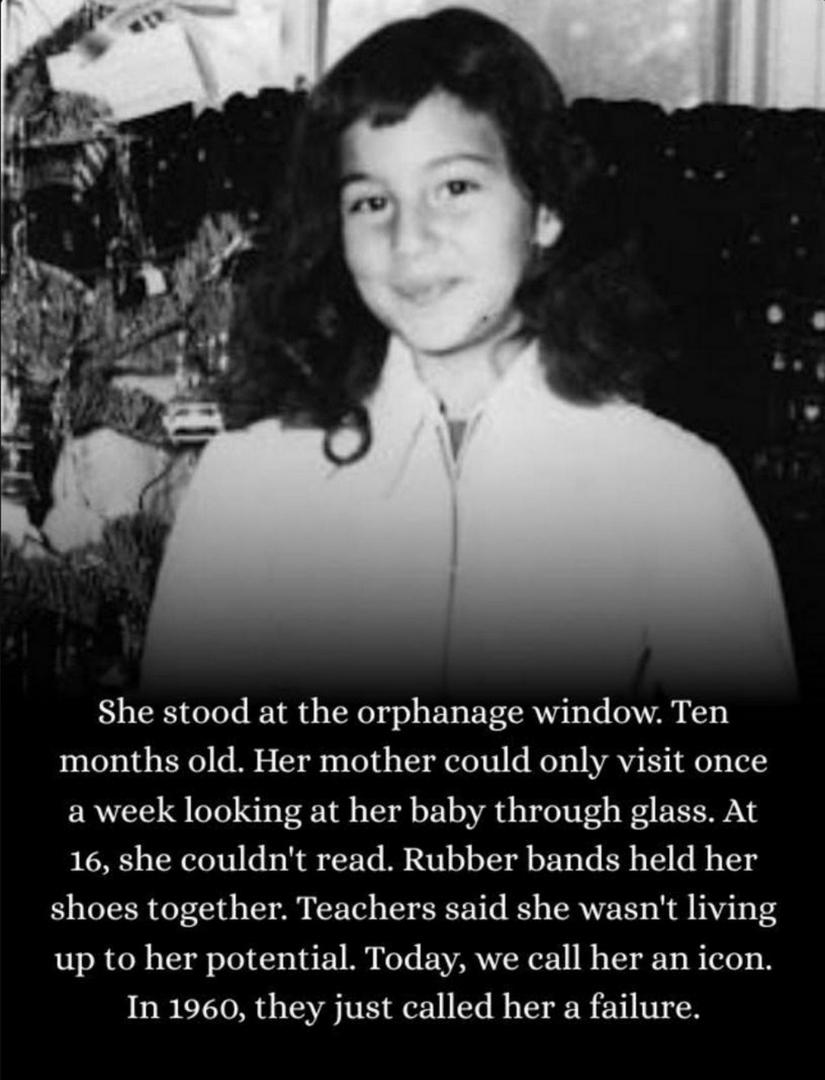
She stood at the orphanage window. Ten months old. Her mother could only visit once a week-looking at her baby through glass. At 16, she couldn't read. Rubber bands held her shoes together. Teachers said she wasn't living up to her potential Today, we call her an icon. In 1960, they just called her a failure This childhood photo of Cher, taken in the ate 1950s, shows a girl who had no idea she would become one of the most enduring cultural forces of the 20th century Back then, she was just Cherilun Sarkisian And almost everything was working against her. The Abandonment: May 20, 1946. EI Centro, California. Cherilyn Sarkisian was born to John Sarkisian-an Armenian-American truck driver with drug and gambling problems-and Georgia Holt a model and aspiring actress of Irish English, German, and Cherokee descent John Sarkisian was rarely present, John Sarkisianwas rarely present When Cher was iust ten months old, her parents divorced Before leaving, her father did something unthinkable: he placed his baby daughter ir an orphanage for several months. Georgia Holt was allowed to visit once a week. But she couldn't hold her baby. She could only see Cher through a window Both mother ana daughter found the experience traumatic Years later, Cher would barely know her father. Their relationship was volatile. They rarely spoke The Poverty: Georaia Holt remarried in 1951-to actor John Southall, with whom she had Cher's half-sister, Georganne But Holt's marriage to Southall ended when Cher wwas nine. Cher later called him her "real father"-"a good-natured man who turned belligerent when he drank too much." Holt would marry and divorce seven times to six men, frequently moving the family acrossNew York, Texas, and California, Money was always a problem. Cher remembered the humiliation vividly: "| remember being really ashamed of my clothes. I was so hard on my shoes.