Category Page entertainment

justme

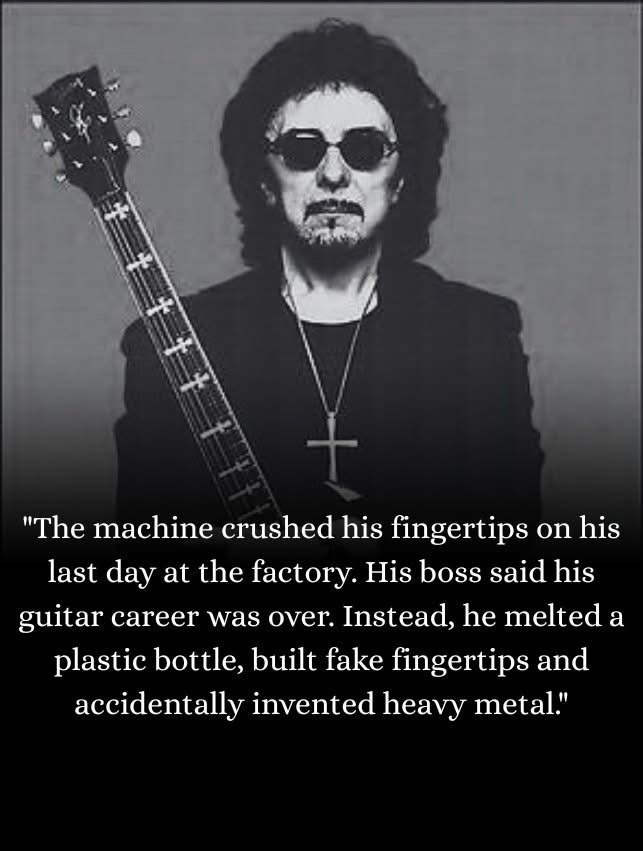
"The machine crushed his fingertips on his last day at the factory. His boss said his guitar career was over. Instead, he melted a plastic bottle, built fake fingertips—and accidentally invented heavy metal. "December 1965. Birmingham, England. Tony Iommi was seventeen years old, working his last shift at a sheet metal factory. It was supposed to be his final day. He'd been offered a professional music gig—a real paying job as a guitarist. He was finally escaping the factory, escaping the grinding industrial monotony of working-class Birmingham. One more shift. Eight more hours. Then freedom. At 4:30 PM—thirty minutes before the end of his shift—Tony was operating a metal press. A massive machine that stamped and cut sheet metal. He was tired. Distracted. Thinking about his new life as a musician. The machine came down. Tony's right hand was underneath it. The press severed the tips of his middle and ring fingers on his right hand—his fretting hand. Blood everywhere. Bone exposed. The fingertips were gone. Crushed beyond repair. When Tony woke up after surgery, heavily bandaged, the first thing he thought about wasn't the pain. It was his guitar. And the second thought: My life is over. For a guitarist, losing fingertips on your fretting hand is catastrophic. Those are the fingers that press down on strings, that create chords, that make music possible. Without fingertips, you have no sensitivity. No control. No ability to feel where the strings are. Tony's factory foreman visited him in the hospital. "Look on the bright side," the foreman said. "At least you weren't going to make a living with your hands anyway. "Tony stared at him. "I'm a guitarist. "The foreman went pale. "Oh. Well... I suppose you'll have to find something else to do. "Tony went home to his parents' house, his hand wrapped in bandages, his dreams destroyed. He was seventeen

LataraSpeaksTruth

People love to say hip-hop isn’t music like rhythm, tempo, and structure suddenly stopped counting when a rapper touched the mic. There’s a beat…there’s cadence…there’s flow…if it makes your head nod without you asking permission, congratulations, that’s music. Period. No think piece required. What always cracks me up is the comparison math folks do in their heads. They’ll dismiss hip-hop, but defend heavy metal like it’s Beethoven reincarnated. Sir…half the time it’s screaming layered over distorted guitars, lyrics buried so deep you need a Ouija board and a lyric sheet. Folks call that “raw emotion” but somehow a clear beat, storytelling, and rhythm is where the line gets drawn. Make it make sense. Hip-hop didn’t just show up yelling into a void. It’s poetry, timing, breath control, metaphor, social commentary, and musical discipline. Artists like Rakim, Public Enemy, and Nas built entire musical architectures with words and rhythm alone. That’s not noise…that’s craft. And here’s the quiet part people don’t like saying out loud. When folks say “hip-hop isn’t music,” what they often mean is “I don’t respect where it comes from or who created it.” Because the same people will turn around and praise bands like Metallica or Slayer for being aggressive, dark, or chaotic. Suddenly distortion equals artistry, but rhythm equals…what, a problem? I don’t listen to much of today’s music. A few songs here and there, maybe, but it’s just not really my thing anymore. That doesn’t change the fact that hip hop is music. There’s a beat. There’s rhythm. There’s structure. If it makes you move, nod your head, or feel something, it qualifies. A personal preference doesn’t erase a genre. You don’t have to like everything to recognize what it is. Hip hop has always been music.


LataraSpeaksTruth

Beyond the Character: The Enduring Legacy of Don “D.C.” Curry

You know how every family’s got that one uncle who’s a little too loud, a little too proud, and somehow still the smoothest man in the room? Yeah. D.C. Curry took that dude, sprinkled some wild outfits on him, seasoned it with real-life uncle energy, and served it up like a Sunday plate. And boom—Uncle Elroy was born. What made the character hit so hard is exactly what you said: the authenticity. Curry didn’t act like Uncle Elroy—he embodied him. He walked in like the mortgage was paid off, the Cadillac was freshly waxed, and the lottery money still had that new-money shine. And he delivered every line with that “I’ve lived this” swagger you just can’t fake. But the real sauce? D.C. Curry had already done the groundwork. His stand-up was this perfect mix of porch wisdom and front-row foolishness. The man could pivot from life lessons to pure clownery like it was nothing. And because he’d mastered that voice—real, rooted, and razor-sharp—Hollywood didn’t mold him. He molded Hollywood’s memories. Uncle Elroy wasn’t just comic relief; he was representation. He felt like the neighborhood. He felt like the family BBQ. He felt like that relative who always has advice you didn’t ask for but kinda needed anyway. And that’s why his legacy sticks: Curry didn’t chase trends. He didn’t try to be “bigger.” He didn’t water himself down. He just brought who he was—loud, proud, wise, wild, and endlessly funny. And in doing so, he gave us a character that still gets quoted, still gets referenced, and still gets laughed with, not at. D.C. Curry didn’t just make Uncle Elroy iconic… he made him immortal. #DCCurry #DonDCCurry #ComedyLegend #StandUpIcon #BlackComedyHistory #LataraSpeaksTruth

Beyond the Character: The Enduring Legacy of Don “D.C.” Curry