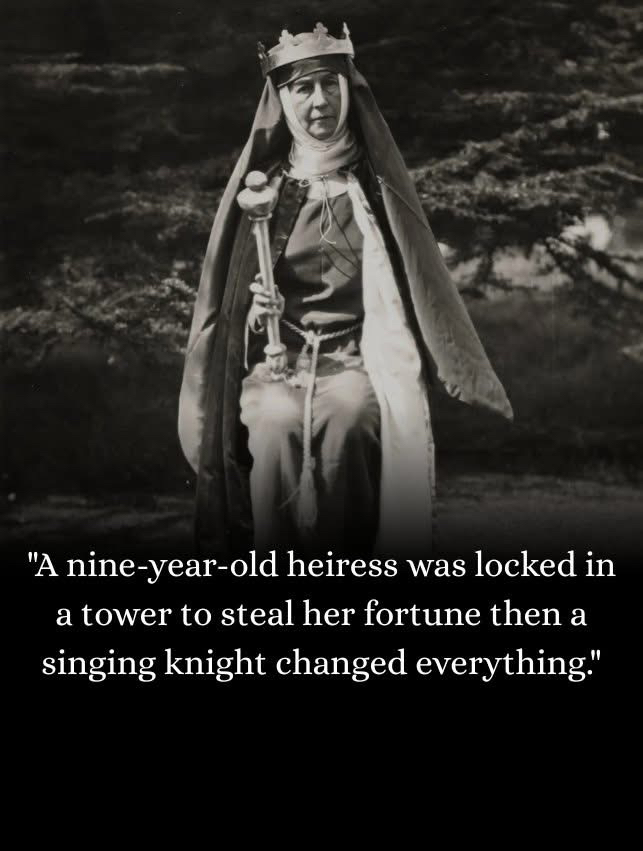
A nine-year-old heiress was locked in a tower to steal her fortune—then a singing knight changed everything.
England, 1196. When the Earl of Salisbury died, his nine-year-old daughter Ela became one of the wealthiest heiresses in the kingdom.
In medieval England, that didn't make her powerful. It made her a target.
Her own uncle saw the opportunity. Before anyone could protect her, Ela vanished. Smuggled across the sea to Normandy. Hidden away in a fortress where no one would find her. The plan was simple and cruel: keep her locked away, forgotten, while he claimed her title, her lands, her inheritance.
She was just a child. An orphan. Easy to erase from history.
But someone refused to forget her.
An English knight named William Talbot began one of the strangest rescue missions in medieval history. He traveled to Normandy, disguised as a pilgrim, wandering from castle to castle. At each fortress, he would stop beneath the high stone windows and sing—ballads, songs, melodies that would carry through the walls.
He was listening for one voice to answer.
For two years, he searched. Castle after castle. Song after song. Most would have given up. Most would have assumed the girl was dead, or that the rumors were lies.
But Talbot kept singing.
And one day, from a window high in a Norman tower, a voice sang back.
He had found her. Ela of Salisbury was alive.
The details of how he freed her are lost to time—whether through cunning, bravery, or luck—but Talbot managed to bring Ela back to England. He presented her to King Richard I, who immediately arranged her marriage to his own illegitimate half-brother, William Longespée.
It sounds like the end of a fairy tale, doesn't it? The rescued princess marries the prince and lives happily ever after..
She and William had a genuine partnership. Together, they laid the foundation stones for Salisbury Cathedral